Susquehanna Morning

Susquehanna Morning

Sunday, March 12, 2017

Lent 10: In which we interrupt the story of Sarah to explain the sin of Sodom and Gomorrah

"Abraham and the Three Angels" by Jacques Joseph Tissot (1836-1902)


When we look at scripture in our church's Monday evening bible study, we always pay attention to context. In fact, the way we most frequently approach scripture is by reading a single book all the way through. So, each time we meet, we begin with "Now, last time, we were reading..." and we move on from there.

It is vitally important to understand: the story of Abraham and Sarah's hospitality is linked with the "sin" of Sodom and Gomorrah. They are one story, and they illuminate one another.

The story of the last post was titled "On Hospitality. And Laughter." I used the last post to talk, a bit, about the Ancient Near East culture of hospitality, as I understand it.

Immediately after that passage concludes, the story turns to Sodom and Gomorrah.

Then the men set out from there, and they looked toward Sodom; and Abraham went with them to set them on their way. The Lord said, “Shall I hide from Abraham what I am about to do,  seeing that Abraham shall become a great and mighty nation, and all the nations of the earth shall be blessed in him? No, for I have chosen him, that he may charge his children and his household after him to keep the way of the Lord by doing righteousness and justice; so that the Lord may bring about for Abraham what he has promised him.” Then the Lord said, “How great is the outcry against Sodom and Gomorrah and how very grave their sin! I must go down and see whether they have done altogether according to the outcry that has come to me; and if not, I will know.” ~ Genesis 18:16-21

Remember: The chapter began with three men visiting Abraham and Sarah, and then the three men (or one of them?) was identified as "The LORD." There is a similarly slippery identification going on here. "Three men" become "the LORD" and two angels. Talking amongst themselves/ Godself, they wonder: Shall we let Abraham know what's about to go down?

Sodom and Gomorrah are already known as places where righteousness and justice are not practiced or honored. The LORD is ready to render judgment.

In verse 22, the "men" and the LORD separate again  Two men (angels?) head towards Sodom, and Abraham has an extended conversation with the LORD (read it here) in which he attempts to bargain for the life of the city. In the end, the LORD promises to save the city if there are only ten righteous men in it.

In chapter 19 we encounter the source of the confusion about Sodom and Gomorrah. The two men, now identified as angels, come to the city. They are greeted by Lot, who offers them good hospitality, just as his uncle had. The angels/ men want to spend the night in the square, but Lot strongly urges them to come under his roof-- i.e., his protection.

You know what happens next: the "men of the city" try to gain access to the strangers, in order to gang rape them. (Lot offers his virgin daughters, rather than yield the travelers to whom he has promised hospitality, i.e., safety.

For a long time this story has been a favorite Christian proof text in support of the argument that what is being condemned here is "homosexual behavior."

Gang rape of men by men is not homosexual behavior, any more than gang rape by men of women is heterosexual behavior. The crime that is attempted here is about violence and power and fear of the "stranger"-- the traveler. 

This is a crime against hospitality.

This story is presented over and against the perfect biblical depiction of hospitality because the crime of Sodom and Gomorrah is inhospitality-- refusing to welcome the stranger, but instead, preying upon him.

This was the guilt of your sister Sodom: she and her daughters had pride, excess of food, and prosperous ease, but did not aid the poor and needy. ~Ezekiel 16:49

We now return you to your regularly scheduled blogposts.

Saturday, March 11, 2017

Lent 9: On Hospitality. And Laughter

"Three Figures Announce to Abraham the Birth of Isaac " by Alexander Ivanov (early 19th c.)


It's like a dream.

It's a warm day, by the oaks of Mamre. As the heat rises from the ground, Abraham takes shelter at the entrance to his tent.

He is neither in nor out, but he is at the threshold. He is in a liminal space, a space where anything is possible, anything might happen, all possible futures still stand open. He is not what or who he will be; nor is he who he has been.

In the heat of the day, three figures arrive.

Abraham receives them as royalty. He invites them to rest under a tree, to take some water to wash their feet (and, presumably, to drink), and to rest while he brings them "some bread." (Actually, while Sarah prepares a feast.)

This is biblical hospitality. This is how you are supposed to receive anyone-- anyone-- who shows up at your dwelling. In a climate where it is often too hot and there is usually a real hunt for water, knee-jerk hospitality is a strict part of the social compact. Anyone could die out there; next time, it could be you.

So, this is how you receive guests. This is all exactly the way it should be.

After serving the bread and some yogurt and the calf Abraham has slaughtered and Sarah has prepared, Abraham stands under the tree near his guests while they eat.

It has to have been hours since they arrived. Abraham slaughtered a calf and Sarah cooked it.

It starts to get weird when the conversation begins.

Where's Sarah, your wife? they ask.

She's inside...

Then one of them says,

“I will surely return to you in due season, and your wife Sarah shall have a son.” And Sarah was listening at the tent entrance behind him...  ~ Genesis 18:10

It is like a dream. 

Sarah is standing at the entrance of the tent.

She is neither in nor out, but she is at the threshold. She is in a liminal space, a space where anything is possible, anything might happen, all possible futures still stand open. She is not what or who she will be; nor is she who she has been.

In the midst of the dreamy scene, the alert biblical reader notices some seams in the story; we are told something we already know, as if we don't know it. 

Now Abraham and Sarah were old, advanced in age; it had ceased to be with Sarah after the manner of women.  ~ Genesis 18:11

And Sarah cackles to herself, at the thought that she might know the pleasure of sex again.

Sarah laughs.

And now the dreaminess returns... because, suddenly, it's not "three men," but "the LORD," who calls Sarah out on her laughter.

(Abraham laughed too. No one called him out on it. Just saying.)

Is anything too wonderful for the LORD? I/ We will be back this time next year, and there will be a bouncing baby boy for you two crazy kids.

And the scene ends on a repeat and fade.

"I didn't laugh."

"Yes, you did."

"Did not."

"Did too."

And, scene.

Lent 8: Sarai/ Sarah: The Covenant

"Righteous Abraham and Sarah" Icon by Michael Golz

Sarai is impacted by two vitally important events that happen to other people.

First: Hagar, Sarai's Egyptian slave, bears a son, and Abram names him Ishmael (God hears), as the angel foretold.

Is Sarai there? Does she act as midwife for her slave? Is the child born between her knees, as they say such births occur?

Abram is eighty-six when the birth occurs. Eleven years have passed since the initial promise.

Second: Another thirteen years pass, and Abram has another encounter with his God. When he is ninety-nine, God appears to Abram.

What have these thirteen years been like? Has Sarah well and truly adopted Ishmael as her own? Does she love him? Or is it well known and accepted that Hagar, despite convention and despite the legalities involved in slavery, is well and truly his mother?

During the course of Abram's encounter with God three things happen:

  • God renames Abram ("exalted ancestor"). Now his name is Abraham ("ancestor of a multitude"): the naming renews and reinforces the promise of offspring.
  • God informs Abraham that they are entering into a covenant, and that the sign of the covenant will be circumcision of all males, whether free-born or slaves, who are members of Abraham's household, and the households of his descendants, forever.
  • And God renames Sarai ("my princess"; this could be taken as a name of personal endearment). Now she is Sarah (straight up "princess," a name connoting royal status), and for the first time, God explicitly names Sarah as being a part of God's covenant promise of children.

She WILL be the mother of Abraham's children.

She is ninety.

Abraham goes into hysterics. Abraham laughs like hell. Abraham falls on his face laughing.

He reminds God of Sarah's age. God holds fast.

He reminds God of Ishmael. Abraham has fatherly feelings for Ishmael! The boy is thirteen years old now, and Abraham has evidently believed that the covenant promise was fulfilled in Ishmael. Abraham want's the covenant to be fulfilled through Ishmael.

God reassures Abraham of blessings for Ishmael, but God insists, Sarah is part of this promise, and the child God has in mind will be named "Isaac," a name meaning "laughter."

Laughter is in Sarah's future, as well as Abraham's.

But it is not here yet.

Friday, March 10, 2017

Lent 7: Hagar and Her Mistress and the Living One Who Sees


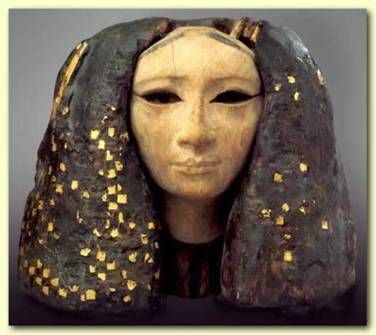
 Head from a statue of a woman from the Twelfth Dynasty pyramid of King Sesostris at Lisht www.touregypt.net

We interrupt the story of Sarai, because this next part insists on being told from the point of view of Hagar.

You can read it here.

Hagar the slave. (If your translation says, "servant," or "handmaiden," get a better translation. I say this with some regret, because I really like the Common English Bible, but I think it gets this one wrong.)

Hagar the Egyptian slave. So, she stands as a reminder-- if that's the right word-- of something that will happen later: Hebrews will be enslaved by Egyptians. She is also, perhaps, someone who was obtained as a result of the time Sarai spent in Egypt.

Hagar the Egyptian is a slave belonging to Sarai, the wife of the fabulously wealthy Abram. Living in close proximity to her mistress, Hagar is undoubtedly aware of a growing tension around Sarai's childlessness. That does not mean she is in anyway prepared for what happens next, no matter the culture of the time, no matter the uses of slaves.

Renita Weems (in her work Just a Sister Away: A Womanist Vision of Women's Relationships in the Bible, 1988) , describes the disparities between the women here:

Sarai had social standing, as Abram's wife, but she had no respect. She had material abundance, but she was not comforted. She was beautiful, but she was barren, childless, less than a woman in the eyes of her Hebrew community. That which Sarai craved most, her husband's money could not buy her. Only her slave's womb could give it to her. And according to custom, because Hagar belonged to Sarai (through Abram, of course), any children Hagar bore would legally belong to Sarai. Thus, what the Lord had prevented of Sarai, Sarai set out to obtain through her slave.

Hagar is given to Abram as a surrogate. As a slave she has no agency, no right to refuse.

The story is told from the point of view of Sarai in the biblical narrative, but it cannot help giving us room to identify and sympathize with Hagar. And it gives us a lot.

After Hagar conceives, the story turns to vision and seeing as a metaphor, a touchstone throughout the rest of the passage.

"... and when she saw that she had conceived, [Hagar] looked with contempt on her mistress." (In the Hebrew, "her mistress was despised / trifling in her eyes.")

Whatever Sarai expected, it was probably not this.

Weems writes:

Before, Hagar had been a defenseless slave. Now, as the pregnant concubine of the prosperous but old man Abram, Hagar was protected. She ceased to be Sarai's slave and became Abram's wife.

Perhaps the pregnancy awakened something in the slavewoman, something that previously lay dormant.

Perhaps it was her sense of self-worth.

Perhaps it was her sense of purpose and direction.

Or perhaps, it was the prospect of being loved unconditionally by the child. (Pregnancy has had that effect on more than one woman.)

Whatever the reason, Hagar could no longer see Sarai and her relationship to her mistress as before, for Hagar was able to give the old man Abram something his wife Sarai could not....

Sarai is enraged, and brings the full extent of her wrath on her husband:

"May the wrong done to me be on you! I gave my slave-girl to your embrace, and when she saw that she had conceived, she looked on me with contempt. May the Lord judge between you and me!"

Sarai knows that, in the end, this is about her power or lack thereof... and Abram seeks immediately to rectify that imbalance by telling her, Do what you want. She is your slave.

And so Sarai "deals harshly" with her... 

(In the Hebrew, this language is identical to the language used to describe the Pharaoh's behavior towards the Hebrew slaves in Exodus. It is the language of punishment and humiliation.)

Hagar runs away, into the wilderness. She would rather take her chances with the hostile natural environment than stay another moment to endure whatever harsh treatment Sarai is doling out.

Hagar the slave.

Hagar the Egyptian slave.

Hagar, the pregnant Egyptian slave.

What happens next is the first annunciation by an angel we find in scripture. It is an annunciation to a pregnant slave. 

And that is almost all you need to know about God.

An angel finds Hagar by a spring of water, and at first, gives Hagar a bitter word.

Return to your mistress. Submit to her. (v. 9)

And this is followed by the annunciation:

“Now you have conceived and shall bear a son;
    you shall call him Ishmael,
    for the Lord has given heed to your affliction. 
 He shall be a wild ass of a man,
with his hand against everyone,
    and everyone’s hand against him;
and he shall live at odds with all his kin.”  ~Genesis 16:11b-12

The angel gives Hagar a vision of her son... not as the abstraction a baby can be in early pregnancy, laden with the mother's fantasies and hopes, but as he will be.  

A child whose name "Ishamel" will mean "God hears"... the cries of this pregnant slave in the wilderness. 

A "wild ass of a man" whose description as a fighter may give Hagar precisely the tangible hope she needs.

And so Hagar does what no other person in scripture has done: she gives God a name. 

So she named the Lord who spoke to her, “You are El-roi” (that is, God of seeing/ God who sees) she said, “Have I really seen God and remained alive after seeing him?" ~ Genesis 16:13 

And the well that was eventually built around the spring bore a name testifying to Hagar's experience: Beer-lahai-roi, Well of the Living One Who Sees Me.

The Living One Who Sees Me.

The first slave we encounter in scripture receives an annunciation, and names God, and leaves behind a spring of water named for her encounter with the divine.

She also returns, at divine command, to her harsh mistress, so let's not pretty this up too, too much. Hagar's story is not over. Nor is Sarai's. 

But thanks be to and for the Living One Who Sees the harsh treatment those in power dole out to those who are powerless. Their time will come.


Thursday, March 9, 2017

Lent 6: Sarai's Weird Adventure

"Sarai Is Taken to Pharaoh's Palace" by Jacques Joseph Tissot (1836-1902)


Dollars to donuts no one reading this post has heard a sermon on this passage. (Unless you went to seminary. All bets are off, when it comes to seminary preaching.)

(Go ahead and read it here. I'll wait.)

Abram and Sarai and all their retinue are forced to migrate to Egypt because of famine.

(Forced immigration for the sake of survival. It's always been a thing.) 

But as they're about to hand their passports to Mizrayim Border Patrol, Abram turns to his wife, and says, "You know, honey, you are just so beautiful...."

And proceeds to sell his wife. Literally, to sell her. To the pharaoh. For the purpose of her becoming... a concubine? A wife? A member of the royal harem?

That's not how Abram poses it to Sarai, of course. He avows that her beauty is so great, the Pharaoh will kill him (Abram) in order to possess her. Therefore, my love, won't you say that you're my sister?

Family relationship norms in the Ancient Near East were not what they are today. In fact, Sarai's being Abram's sister would only have prevented their marrying if they had been womb-siblings (children of one mother), who were considered too close a relation to marry. If they had been siblings by a father, there would have been no problem. (More on that later.)

In other words, Abram's logic is not entirely.... logical.  But there you have it. Sarai (we must assume) agrees (we don't know how enthusiastically), the two enter Egypt, and word of Sarai's beauty travels quickly to Pharaoh, who promptly takes possession of her.

And Abram becomes a very, very rich man.

BUT. There is a promise of God, still echoing in the air. The promise is that Abram (and by inference, Sarai) will be blessed with a child or children, which will result in their becoming a "great nation."

This escapade puts the promise in serous jeopardy. Will Sarai lie with the Egyptian king? Will she become pregnant? What will that do to the promise of God?

I wonder: does this story reveal some anxiety about something that becomes a central marker of Judaism? By which I mean: matrilineal descent, the passing of Jewishness, not through the father, but through the mother. If covenant belonging is passed through the mother and not the father, then there is a certain lack of control on it, isn't there? Control by men, I mean. Which... as the biblical narrative unfolds, becomes more and more of a concern, at least if you think Leviticus reveals anything about it.

Another sign that this is a tremendous anxiety? This story is told, not once, but three times. In reference to Sarai/Sarah, here and in chapter 20, and about Rebekah in chapter 26! A completely different woman!

I find this fascinating.

(Another marker of the concern about how Jewishness is identified? Circumcision. See chapter 17.)

But here, as this story reveals, the power is with, and in, the woman. She is the one through whom descendants will (or won't) appear.

In the end, God intervenes on behalf of the covenant, in scripture's very first show of plagues. Pharaoh is, understandably, miffed, and calls Abram out on it. And Abram went on his way, "with his wife and all that he had."

A final note about matrilineal descent, from chabad.org. It a contemporary Jewish (Orthodox/ Hasidic) answer to the question, "Why is Jewishness passed through the mother?"

Jewishness is not in our DNA. It is in our soul. The reason it is passed down through the maternal line is not just because it is easier to identify who your mother is. It is because the soul identity is more directly shaped by the mother than the father.

From a purely physical perspective, a child is more directly connected to their mother. The father's contribution to the production of a child is instantaneous and remote. The mother, on the other hand, gives her very self to the child . The child is conceived inside the mother, develops inside the mother, is sustained and nourished by the mother, and is born from the mother.

This is not to say that a father and child are not intimately attached. Of course they are. But as deep and essential as the bond between father and child may be, the child's actual body was never a part of her father's body. But she was a part of her mother. Every child begins as an extension of their mother's body.

The children of Israel did indeed begin as an extension of Sarai's body. But not yet. There are more adventures-- and obstacles-- between now and then.


Tuesday, March 7, 2017

Lent 5: Sarai


When I was twenty-nine years old and the mother of a beautiful, rambunctious toddler, my (then) husband received a call (by which I mean, a very nice offer from a particular university that wanted him to come into their Ph. D. program), to leave his country and kindred and the house on Linden Street, to travel to a new land (by which I mean, to leave the Boston area, where all our friends were, to move to Binghamton, where we knew no one).  And so he did. He left that little Cape Cod house near the commuter rail that had carried him to a law firm for three years, and traveled along I-90 and then I-88 to the little city that would be his home for the next twenty (or so). And I, his wife, went with him.

When Sarai was sixty-five years old and the mother of no one, her husband got the same basic call. The up! Get up! And go! call. I remember, at twenty-nine, being excited. Even though people and a city (all of whom I still love) were being left behind, it was an adventure!

I'm not sure how I'd feel about getting that call at age sixty-five.

Scripture is absolutely silent as to Sarai's opinion on the whole thing, even though-- Oh, I forgot to mention this--  God tells Abram that he will be given three things: land, children, and blessing. Presumably, Sarai is intimately involved in the children part. Presumably.

Ages are funny in scripture. In the first eleven chapters of Genesis, the ages given for the biblical characters are mythic... Adam lived nine hundred and thirty years. Enoch lived three hundred and seventy-five. Noah, nine hundred fifty (he was a spry six hundred when he built the ark).

By the time we reach the stories of the patriarchs and matriarchs, the ages begin to sound more reasonable, though still heroic. The question is, what does sixty-five or seventy-five mean? The same as it does to us? Probably not, but these ages do signify that what is being asked of this couple is exceptional, and unusual. These two who get up! and go! without hesitation, even by this simple, first measure, earn their status as memorable figures in the biblical story.

But what did Sarai think of it all? Was it an adventure to her? Was she weary with age? Or was 65 the old 35, in this still pretty mythic age?

What did Sarai think?


Monday, March 6, 2017

Lent 4: At Last (the very last), Eve

Speaking of moral mischief....

Finally, we are there. The passage from scripture that has been mused most nefariously against women in the Christian context. The passage which gives the author of 1 Timothy the impetus to say,

Let a woman learn in silence with full submission. I permit no woman to teach or to have authority over a man; she is to keep silent. For Adam was formed first, then Eve; and Adam was not deceived, but the woman was deceived and became a transgressor. Yet she will be saved through childbearing, provided they continue in faith and love and holiness, with modesty.  ~ 1 Timothy 2:11-15

Let us take a moment to gaze at the waters of the Gulf Coast, and as the sun sets in the west, to sigh deeply.


What we are witnessing is not a fall. It is not the first sin, though it is the first instance of a painful rift between God and those created in God's image and likeness.

What we are witnessing is a coming-of-age story.

At the end of the second creation story, we are told that they were both naked, the man and his woman (the same word can be used in Hebrew to mean either "woman" or "wife"). They are in a state of innocence. Nakedness does not call for shame, and so they are not ashamed.

The serpent is introduced in chapter 3... a trickster if ever there was one, we are warned of his wily ways up front. He deliberately misstates God's instructions about the Tree of the Knowledge of Good and Evil. The woman, even though she had not yet been created when those instructions were given, knows the score, and sets the serpent straight. (In fact, she reports the instructions as more restrictive than God's original command).

But the serpent persists, and the serpent entices.

Not only is the fruit good to eat; it will give the one who eats it knowledge, insight.

It will help the one who eats it to know the difference between good and evil.

How strange to call the pursuit of that knowledge, "sin."

The woman takes the fruit and eats it. She offers some to her husband, who has been standing, mute, beside her, and he eats it without a word of objection. Their eyes are opened, then, and they realize, on the other side of this act of disobedience, that they are naked, and they learn what shame is. They try to hide-- their bodies and their actions. They fail. God has some harsh words for them. There are consequences. In the end, they must leave their garden home. And the woman receives her name: Eve.

This is a coming of age story. Our parents give us their world view. They give us instructions and warnings. At a certain point, we test the limits of those instructions. Sometimes it turns out ok, and sometimes, not. But our eyes are opened. We experience life on the other side of the line our parents have drawn, and we are wiser for it.

But in each and every case, the expected outcome is exactly what happens here: eventually, in the normal course of events, we leave home.

I'll leave you with the words of Barbara Grizzuti Harrison, who, though she does in fact embrace the "fall" interpretation, also captures perfectly one precious gift of the narrative:

When Eve bit into the apple, she gave us the world as we know the world-- beautiful, flawed, dangerous, full of being... Even the alienation from God we feel as a direct consequence of her Fall makes us beholden to her: the intense desire for God, never satisfied, arises from our separation from him. In our desire-- this desire that makes us perfectly human-- is contained our celebration and our rejoicing. The mingling, melding, braiding of good and mischief in every human soul-- the fusion of good and bad in intent and in art-- is what makes us recognizable (and delicious) to one another; without it--without the genetically transmitted knowledge of good and evil that Eve's act of radical curiosity sowed into our marrow-- we should have no need of one another... of a one and perfect Other... Eve's legacy to us is the imperative to desire. Babies and poems are born in travail of this desire, her great gift to the loveable world. 

From "A Meditation on Eve" in Out of the Garden